England’s Colony? A new BBC series

Press release

BBC WALES TO BROADCAST MAJOR NEW SERIES EXPLORING WALES’ RELATIONSHIP WITH ENGLAND

Presented and written by historian Professor Martin Johnes, Wales: England’s Colony? will challenge some of the most fundamental ideas about Wales’ historical relationship with England and its place in the world.

The two-part series, broadcast on 11 and 18 March at 9pm on BBC Two Wales, is designed to stimulate debate about the past story of Wales, and will also challenge the audience to think afresh about some of the future constitutional choices facing Wales as it leaves the European Union.

Focussing on how Wales’ relationship with England has shaped both the nation’s development and how Wales sees itself, the programmes will tell the story of an uneasy and unequal relationship between two nations living side-by-side. It examines Wales’ story from its creation to the present day, examining key moments such as medieval conquest, industrial exploitation, the Blue Books, the 1919 race riots and the flooding of Cwm Tryweryn.

Johnes argues that the conquest and oppression of the medieval period meant Wales was England’s first colony but that gradually over time the Welsh reconciled themselves to this position and became partners in and beneficiaries of the British Empire. The union of England of Wales was never an equal one but in a democracy Wales has the freedom to choose whether it wishes to remain in the United Kingdom or not.

Professor Martin Johnes says: “History has shaped how we think of Wales but our past is more complicated than we often understand. Part of Wales’ current problem lies in believing that we are, and always have been, victims, powerless to act on our own and to choose our own future.”

The series is part of The Changing Face of Wales season across BBC Wales television, radio and online – looking at what it means to live in Wales and to be Welsh at a time of unprecedented change.

This spring, BBC Wales will launch a series of history podcasts where Professor Martin Johnes will be joined by guests to discuss some key questions in Welsh history such as whether Wales was ever an independent nation, and were the Welsh miners truly radical?

Ends

Issued by BBC Wales Communications

History and the politics of Welshness

History can be very emotive. The destruction of an iconic piece of graffiti has upset many in Wales this week. It has led to assertions that this is the result of an ignorance of Welsh history. Some claim this ignorance is deliberately imposed on Wales. There are calls for Welsh perspectives on the past. There are demands that children learn more about medieval conquests and rebellions, the Tudor annexation of Wales, and the suppression of the Welsh language. The hope is that this will bolster people’s sense of a political Welshness.

While in Wales there are calls for more Welsh history to be taught, in England there are calls for more British history in schools. These are sometimes grounded in patriotism but they are also sometimes rooted in the hope that it will curtail the kind of Britishness that can lead to xenophobia, exceptionalism, and arrogance. The British patriots want more tales about contributions to science, the defeat of fascism, and the benefits of imperialism. Their critics on the left want more appreciation of the evils of imperialism, the role of immigration in building British society, and the long roots of European connections.

What this debate should remind us in Wales of is that history is complicated and can be interpreted in multiple ways. It should remind us that there is no single Welsh point of view that can replace the British perspective that is so often disliked. The refusal of the local council to oppose the flooding of Cwm Tryweryn is a reminder of how divided Wales can be.  Just as Wales was not united in its opposition to Tryweryn, nor was it united in supporting Glyndŵr’s rebellion or in its desire to preserve the Welsh language. Indeed, there have been times when the British state was more progressive in its attitudes to Welsh than large chunks of the Welsh people.

That is partly because some of the people running the state were Welsh. British history is Welsh history too. The tragedies and achievements of the First and Second World Wars, the building of a global empire on the back of the exploitation of others, the beliefs in racial and gender hierarchies, and the legal and cultural advances towards equality are all parts of Wales’ history. Yet people who studied some of these things at school still say they were taught no Welsh history.

History will always be political. It will always be used and abused. But the task for the historian is to try to challenge that, to raise, as another historian put it, awkward truths. And most of those awkward truths are also far from simple. Churchill was both a racist and a good war leader. The Welsh have been both oppressed and oppressed others. Glyndŵr was both a rebel that did significant damage to his own people and a freedom fighter who helped his nation survive. Tryweryn was both a national injustice and typical of the way English and Welsh people were treated when their homes stood in the way of a reservoir, a road or a slum clearance.

We should teach more Welsh history, not because it will boost Welsh patriotism, but because it will help us understand who we are. It won’t give us simple answers but it will tell us why we should be asking the question. This may well end up boosting a sense of political Welshness but that should not be the primary purpose of teaching Welsh history.

The Welsh independence campaign

logo-yescymruTonight I went to a public talk by the chair of Yes Cymru, the grassroots movement for Welsh independence. Personally, I’m sympathetic but undecided on the issue and these are some brief reflections on the challenges the campaign faces.

For me, Welsh independence has certainly become more visible since Brexit but, in an age of social media echo chambers, it’s difficult to know how representative this is.  I follow a lot of Welsh politicians and academics on Twitter so I see stuff about Welsh independence all the time. However, I have never once heard anyone in my social life bring the issue up. Tonight’s meeting seemed to be mostly converts or people sympathetic.

The challenge is reaching a wider audience. Social media, memes and the like can only go so far. Social media may have helped Corbyn but he lost the general election. It may have helped the Scottish independence campaign but that lost too. It may have helped Brexit but the strongest leave vote came amongst older voters, those who use social media the least. It’s easy to forget that the Leave vote was the culmination of a long and fragmented campaign, which in many ways spent more time convincing politicians than voters. Grassroots alone is not enough.

The Brexit campaign also won because it had a simple, emotional message: take back control. It was simple enough that it could mean anything people wanted it to. It was interpreted as sovereignty, immigration or cash, and probably other things too. With the exception of £350m for the NHS, the Leavers certainly never defined too closely what it meant. They were, in effect, promising everything and nothing. They played on people’s emotions, hopes and fears.

Tonight’s speaker was at his most effective in the Q&A when he spoke from the heart about how he genuinely believed independence would make Wales a better place. He was emotive and clearly believed this. This made him convincing; no one could possibly doubt his sincerity. The Yes Cymru case will be at its strongest when it moves away from specifics and appeals to the  emotional patriotism of the people of Wales. It needs to speak from the heart more.

The campaign does have a message. Wales is the poorest part of the UK; we are governed by a remote London government and by a Cardiff government hamstrung by the lack of power it is given. This bit is factual but it only gets you so far. The emotional part of the Yes Cymru message is that we could do better if we took control of our lives, our communities, and our nation. That’s the bit that can convince doubters. That’s what the Brexiteers played on.

Yet Brexit is now a dog’s dinner because behind its emotional rhetoric of taking back control was nothing of any substance. You might win the battle with emotion but you don’t win the war. (And Brexit will ultimately fail. We may leave the EU in the short term but the next generation will take us back.)

Yes Cymru have to learn from that dog’s dinner. There has to be some substance and some plan. You can only get so far saying the campaign is non-political and it’s for parties to work out what independence would mean in practice. To be fair, there was some detail and the potential of independence to rethink how the economy and our society function is persuasive. And there’s nothing wrong with admitting there are risks and it won’t be easy.

The key lesson of Brexit is that breaking up a political and economic union is not easy. Quickly unravelling forty-odd years of union without destroying the economy is proving impossible. Doing the same to a union of 500-odd years will be even more so.

If independence is to happen without huge economic turmoil, it will have to be a gradual process rather than event. It might even take decades. Indeed, no nation is entirely independent in a world where trade, the environment, human rights and so forth are internationally regulated. Making claims of independence giving Wales the freedom to do anything is misleading.

The break up of the UK is probably coming but if it is not to be an economic catastrophe then those seeking it in Wales and Scotland have to accept that the hashtags calling for the immediate dissolution of the union are just as misguided as the Leavers who promised Brexit would be easy. A federal UK should be the next step they are aiming for.  That doesn’t mean abandoning an independence campaign. It doesn’t mean not pulling on the heart strings of patriotism. But it does give people time to work out the practicalities and to avoid the backlash heading the way of Farage, Boris and co, when the electorate realise they were sold a lie.

Of course, for some leaving the EU at any cost is important. Similarly, for some, a poorer independent Wales would be better than what we have now. But for me, and I suspect the majority of the people of Wales, independence is only worth seeking if it will improve our society and our lives. This is not a given. As the UK will soon find out, if you don’t work out the details first, significant constitutional change can make things far worse rather than far better.


Memories of Wales says Yes 1997

On 18 September 1997, the Welsh electorate narrowly voted ‘Yes’ on the question: “Do you agree that there should be a Welsh Assembly as proposed by the Government?” The turnout was 50.1%. The Yes majority was 6,721.

At the time, I was a student in Cardiff and very excited by the prospect of devolution.  It was a chance to recognise Welsh nationality and form a different kind of democracy after 18 years of Conservative government.  Like the election of Tony Blair earlier in the year, it seemed to offer a new beginning and I took the opportunity to speak to as many people as possible about it.

My overriding memory of the time, however, is the indifference of most people I knew. Some were clearly in the Yes camp, especially if they spoke Welsh and/or supported Plaid Cymru.  My friends who had voted Labour a few months before were far less enthusiastic. Indeed, many of those who were English seemed to regard the issue as nothing really to do with them.  Some actually stated it should be a decision for those who were Welsh rather than living in Wales.

Even amongst those who were Welsh, there was sometimes a sense that somehow this was a vote on whether Wales’s future should be in the UK. One friend from a Valleys town was distrustful of my arguments because she said I was too “into the Welsh thing”. Others seemed to feel it was too soon after the election of a new government to make such a decision. The Tories had been in power nearly all our lives and some people seemed to want to see how government by New Labour would pan out first.  Few such people probably voted ‘No’ but not many voted ‘Yes’ either.

There may have been little enthusiasm but there was also little active hostility. Only one person told me he was voting No because he wanted less government, not more.

Looking back, I can’t remember why I did not get involved in the Yes campaign. Perhaps I did not know how at a time when the internet was in its infancy. I did get a Yes poster from somewhere and put it up in the window. It was the only poster on our street.

Despite my numerous conversations, it never occurred to me that the Yes campaign might not win.  Just as during the EU referendum, I was assuming that common sense would win out, despite the conversations I was having with people who thought otherwise.  As results night progressed, and it looked like No would win, I got depressed, as much with my own misreading of the situation as with the situation itself.

When Carmarthen, the last county to declare, swung the result, I was ecstatic. I felt I should go onto the streets to celebrate this momentous occasion of national importance.  But I knew no one else would be there. I did open the door but it was raining.

Instead, I watched television pictures of a party somewhere. In the background, I noticed the woman who lived next door. I had never spoken to her and felt a moment of guilt about the lack of community on our street. I wondered why she had not put up a poster in her window.

The next day, no one seemed that excited. A friend who I had persuaded to vote Yes told me she had meant to but the rain had deterred her. I’d like to think the margin would have been better had the sun been out but that would another delusion.  1997 changed Wales forever but it did so on the back of little widespread enthusiasm.

Football and the First World War in South Wales

It is unimaginable that people could look on at a game of football and forget themselves in the ecstasy of a winning goal at the moment when their comrades, maybe brothers, are making gallant and stupendous efforts at the front, even sacrificing their lives for the life of the nation.

Letter to South Wales Daily News, 3 September 1914

In August 1914, war broke out in Europe, driving Britain into a patriotic frenzy. WVery quickly, all rugby matches in England and Wales were suspended to help the nation to concentrate on the push for victory.  There was no similar official suspension in junior and amateur soccer but, with so many players joining up, many competitions were abandoned anyway. By December 1914, 1,217 players affiliated to the South Wales and Monmouthshire FA had enlisted and nearly a hundred clubs had disbanded.  At the end of the season, there were just seventy affiliated clubs still active, 325 fewer than the previous year

The press looked to professional soccer’s authorities to follow rugby’s moral lead but, fearing financial losses and expecting it all to be over by Christmas, the FA and Football League decided to play on.  The FAW followed suit with its president claiming that to interfere with football would be nothing short of ‘panic legislation’.  He argued that soccer fulfilled a large place in the organized life of the nation and that its discontinuation would only produce undesirable results.  Although many professional players had already enlisted, and some of the smaller professional teams disbanded, those clubs that did play on faced a battle of their own.

The government and the War Office may have supported the continuation of professional soccer but elements of the public and press saw things rather differently. The first two months of war saw letters and editorials in south Wales and national newspapers denouncing the playing of soccer during a time of crisis.  It was felt that since footballers were fit young men looked up to by much of the public, they should be setting an example by enlisting.  Some critics believed that playing and watching the game were not necessarily wrong if the players and spectators were too young or too old to enlist.  They accepted that sport had a role in relieving public tension and anxiety. However, the more extreme antagonists felt that the whole concept of spectatorism was wrong in a time of war and the sight of thousands of young and able men enjoying themselves at matches during wartime sickened them.

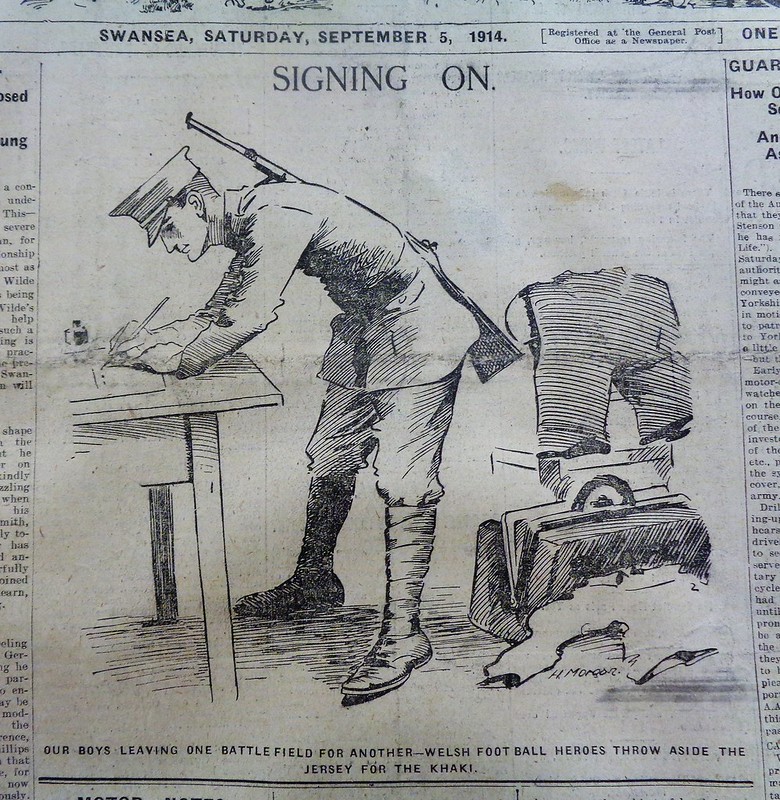
5 Sep 1914

Celebrating rugby’s war contribution: Sporting News (Swansea), 5 September 1914.

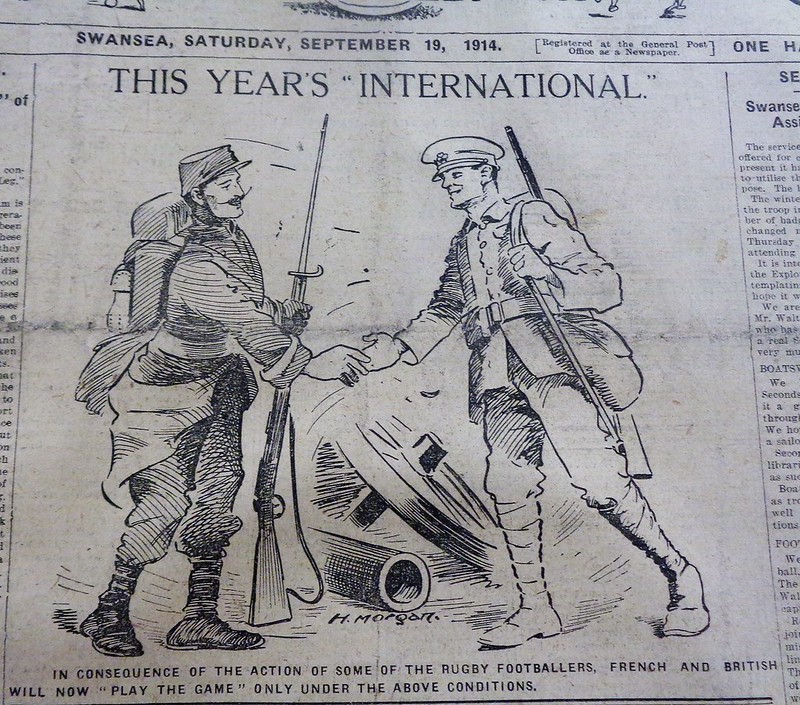
19 September 1914

Celebrating rugby’s war contribution: Sporting News (Swansea), 19 September 1914.

The south Wales press printed lists and pictures of famous, and not so famous, rugby players who had joined up, thus indirectly criticising professional soccer.  The decision of Swansea Town’s directors to contest the military’s decision to requisition the Vetch Field was subtly criticised after one member of the board suggested that the War Office could have the ground if it took over the club’s liabilities.  The implication that the club and the game were putting their own finances before the nation’s needs was made clear by the press article then moving on to look at new recruits from the town’s rugby fraternity.

In an effort to make a stand against the continuation of soccer, the South Wales Argus announced that it would not report any football news for the duration of the war. The South Wales Daily News also chose not to print match reports in the first few weeks of the 1914-15 season but, as attendances showed that the public were still interested in professional soccer, the paper slowly increased the coverage it gave to the game.

Other papers also reversed their stance and made it clear that sport was acceptable during the war.

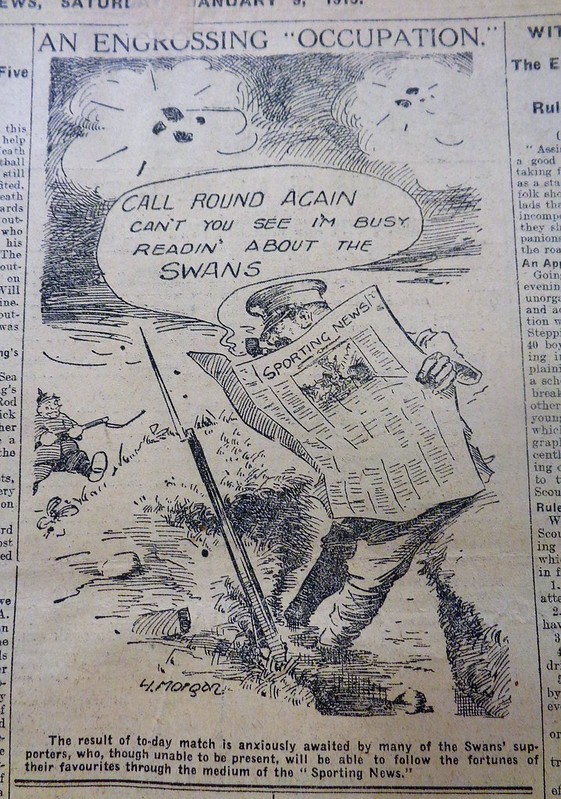
9 january 1915

Sporting News reports on Swansea Town v Blackburn Rovers in the FA Cup, 9 Jan. 1915

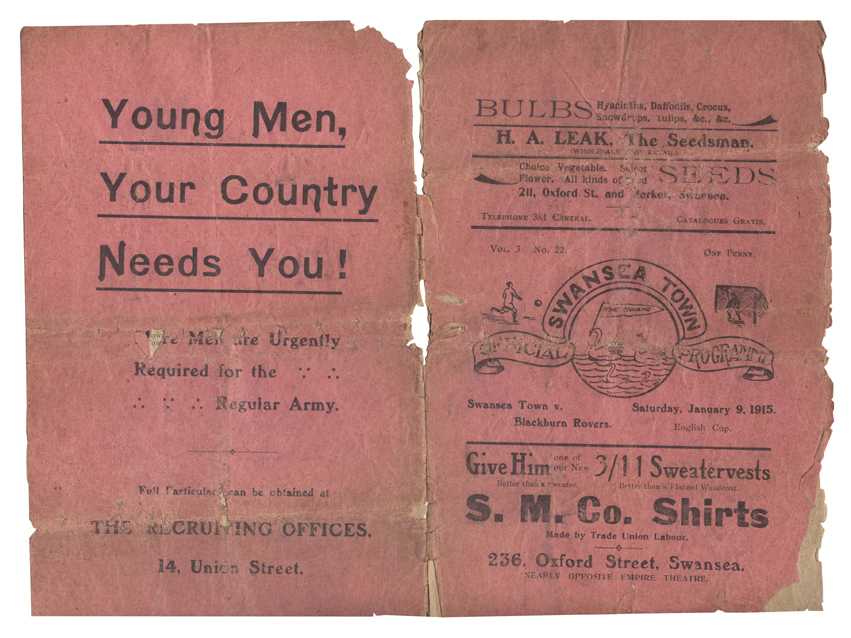
Despite the allegations that professional soccer was unpatriotic, the game was helping the war effort.  Grounds were made available to the military for drill or training at any time other than Saturday afternoons, most clubs gave their players rifle practice, and some even paid them in advance for the 1914-15 season to allow them to enlist.  On occasion, soldiers were let into matches half-price in an effort to show that the game was doing its bit, while spectators regularly found themselves the target of enlistment campaigns. The 7,000 spectators at a Welsh League match between Swansea Town and Llanelly in 1914, a third of whom were eligible for service according to a self-righteous reporter, were addressed by six different speakers, including the mayor and club chairman, on the virtues of enlistment.

blackburn-1915
Recruitment advertisement from Swansea Town v Blackburn Rovers FA Cup match programme 1915 (Swans100 archive)

The immediate impact of such appeals was limited in south Wales.  The Times used the fact that only six recruits came forward after appeals at a Cardiff City match as an example of the selfishness of the game and its followers.  However, as the club pointed out, hundreds of its supporters had enlisted, while the majority of the rest were involved in the coal and rail industries, integral parts of the war effort.

Nationally, soccer gave the state easy access to large numbers of potential recruits from working-class communities and thus became an important vehicle in the recruitment campaign. The wartime hostility towards soccer in England was not widespread and actually represented the resentment of exponents of amateurism at the usurpation of the game by professionalism and the working classes.

In south Wales, antipathy towards soccer was even less common and given disproportionately large publicity by a patriotic press.

Restrictions on rail travel and a ban on mid-week games played havoc with fixture lists and soccer found it harder and harder, in both financial and practical terms, to continue.  In November 1914, the FA estimated that, on average, attendances had fallen by approximately fifty per cent.  Cardiff City’s average in the Southern League dropped from approximately 11,700 to around 9,300. Other clubs, like Mardy AFC of the Southern League, already operating on tight budgets, suffered critical declines in their gates and closed before 1914 was out. The soccer authorities’ restrictions on players’ wages caused further tensions within clubs.  Cardiff City players threatened to go on strike in 1915 over the issue of their benefits.

By the end of the 1914-15 season, it was clear that the war was going to be a long affair and the FA decided to suspend league and cup programmes.  Falling attendances and practical problems had achieved what the anti-soccer agitators could not. A new makeshift league involving Cardiff City, Newport County and teams from south-west England lasted just a season because of low gates and rail restrictions.  Cardiff City’s average attendance during the season was a meagre 1,700.

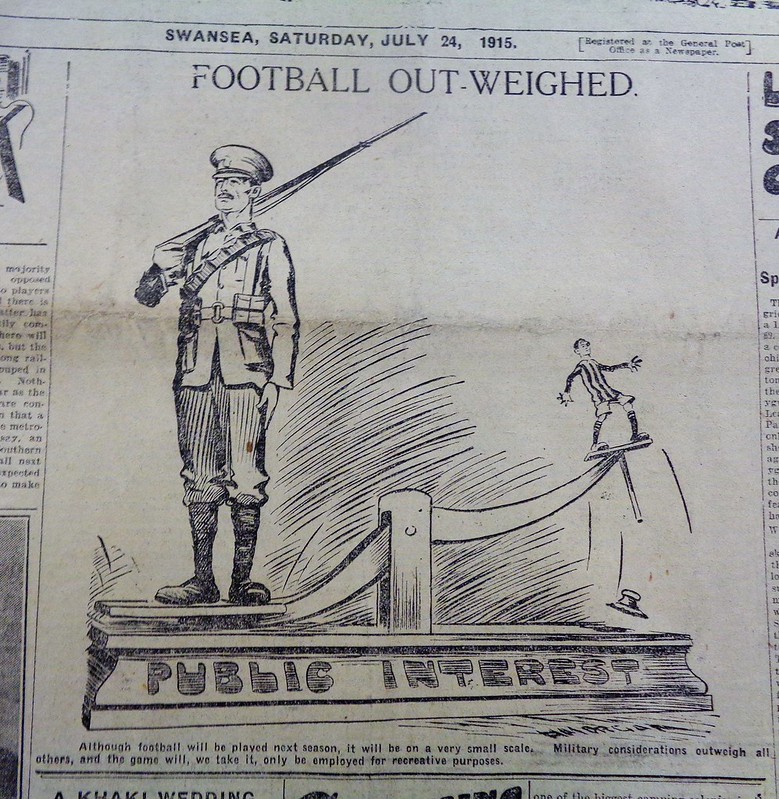
24 July 1915

Sporting News, 24 July 1915

1916 saw the introduction of conscription and the call up of most of the eligible professional players who had not enlisted voluntarily.  Junior leagues did continue throughout the war, offering light relief from the hardships of the home and overseas fronts, but professional clubs spent the rest of the war playing the occasional friendly with teams of amateurs and guest professionals. Without the regular income of popular matches, the expense of paying rent and ground maintenance proved difficult.  Cardiff City, Merthyr Town and Swansea Town survived the war but few other clubs were so fortunate.  Yet the real loss was the 35,000 to 40,000 Welshmen killed in the war, among them a host of amateur, professional and international players.

For those who returned, the war was a watershed in their personal lives.  Fred Keenor of Cardiff City served alongside other professional players in the 17th Middlesex (Footballers’) Battalion and a leg wound threatened to end his footballing career before it had really started.  In later years, he mostly refused to speak of his experiences on the Western Front.  As his son put it, ‘Dad blotted it out. He had lost too many friends. He often said that he was one of the lucky ones who came back’. On being demobbed, the ‘land fit for heroes’ was no more immediately apparent to Keenor than it was to most other returning soldiers.  He found work in a gasworks and on a milk round before rejoining Cardiff City when professional football resumed in 1919 amidst much excitement.

Adapated from Martin Johnes, Soccer and Society: South Wales, 1900-39 (University of Wales Press, 2002).

John Charles and Welsh football

An old article I wrote for Soccer History.

John Charles was one of a generation of immense talent to emerge from the schools of Swansea from the end of the 1930s to the early 1950s.  Most notably, Trevor Ford, Cliff Jones, Ivor and Len Allchurch, Jack Kelsey and John’s brother Mel all went on to become international stars. In the early 1950s Swansea schoolboys won the English schools shield three times. The guidance of local teachers did much to foster this culture of footballing excellence but another local institution, Swansea Town, never benefited from it in the way that it might have.

Charles was lost to his hometown club when Leeds United ‘stole’ him (and several others) from the Swansea Town groundstaff in 1948, after a scout had spotted him playing on a public park. Charles was yet to turn sixteen and was thus technically a free agent, despite an understanding that he and other boys on the groundstaff would sign professional terms for Swansea.  The FA subsequently changed the regulations on player registration to avoid any repetition.

Embed from Getty Images

It was thus on the international rather than domestic stage that Charles contributed to Welsh football. He made his international debut in 1950 against Northern Ireland in the home championship.  As in club football, his international career was at both centre-half and centre-forward.  He helped give Wales an international profile in the game; the secretary of the Italian league remarked in 1961 that ‘Wales should give Charles a medal. He has put it on the map. Nobody in Italy knew where or who it was before’.  Charles won 38 caps for Wales, scoring 15 goals.  It would have been far more had Juventus been happy to release him every time he was called up.  Charles recalled, ‘If they [Juventus] were playing just before or just after an international I would have to stay behind.  It broke my heart.’

Embed from Getty Images

After Wales qualified for the 1958 World Cup his manager and teammates were unclear about whether Charles would be able to participate or not. When the Welsh party left for Sweden Charles was not amongst them.  Juventus, with whom Charles had just won the Italian league, had finally agreed to release him but he was still waiting for clearance from the Italian Football Federation.  Charles himself had not thought that Wales would qualify and thus never thought a problem would arise. When he eventually made it to Sweden he was unexpected and arrived at an airport not knowing where the Welsh team were staying. Charles played in Wales’s three group matches, scoring once.  In the subsequent play off against Hungry he was kicked out of the match and injury prevented him turning out against Brazil in the quarterfinal. Without their star player, Wales lost 1-0 to a Pele goal.

Embed from Getty Images

His desire to play regular international football contributed to his signing for Leeds United in 1961. After he quickly returned to Roma he insisted on a clause in his contract allowing him to play for Wales.  Charles finally played for a Welsh club when he joined Cardiff City from AS Roma in 1963.  By then he had lost some pace and played mostly in defence.

In 1966 he moved on to join Hereford United as player-manager before returning to Wales to become manager of Merthyr Town in 1971 and then becoming assistant manager at Swansea in 1973 after a brief spell in Canada. Charles stayed at Swansea for three years before moving to Leeds to run a pub.  He was never a success in management, be it in football or business; perhaps his temperament was too genial.  But this did not sully the memories of those who had met him or seen him play.  With his greatest playing achievements taking place on the continent in an age before widespread television coverage, Charles was never as revered in Wales or the UK as he was in Italy. Nonetheless, he surely remains the greatest footballer ever to emerge from this small nation.

Martin Johnes is the author of: Soccer and Society: South Wales, 1900-39 (University of Wales Press, 2002).

The Political Aftermath of the Aberfan Disaster

Martin Johnes and Iain McLean

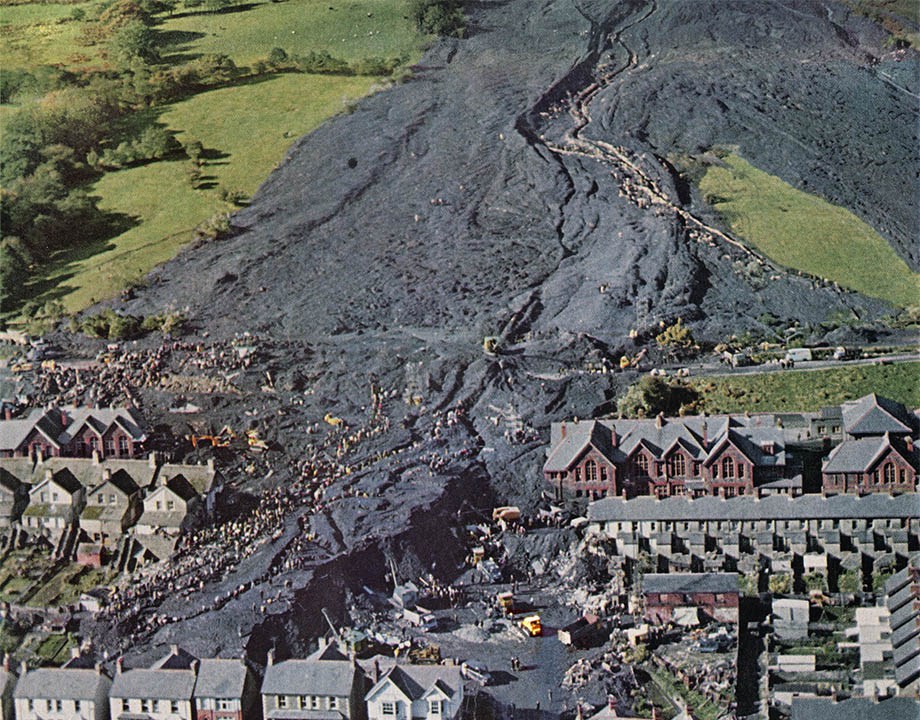
On Friday, 21 October 1966 a coal tip slid down a mountainside into the mining village of Aberfan in the South Wales valleys.  The slide engulfed a farm, around twenty houses and part of the local junior school before coming to rest.  The disaster claimed the lives of 144 people, 116 of whom were school children.  The horror felt around the world was made all the more poignant as news emerged of previous slides and brushed aside warnings.  Such was the widespread sympathy that was felt that a fund set up to help the village raised £1,750,000.

Image result for aberfan disaster

A terrifying tale of bungling ineptitude

In the days after the disaster, Lord Robens, chairman of the National Coal Board (NCB), attributed the tragedy to ‘natural unknown springs’ beneath the tip.  This was known by all the local people to be incorrect.  The NCB had been tipping on top of springs that are shown on maps of the neighbourhood and in which village schoolboys had played.  The government immediately appointed a Tribunal of Inquiry.  Its report was unsparing:

Blame for the disaster rests upon the National Coal Board … The legal liability of the National Coal Board to pay compensation for the personal injuries (fatal or otherwise) and damage to property is incontestable and uncontested.

These dry conclusions belie the passion of the preceding text.  The Tribunal was appalled by the behaviour of the NCB and some of its employees, both before and after the disaster:

the Aberfan disaster is a terrifying tale of bungling ineptitude by many men charged with tasks for which they were totally unfitted, of failure to heed clear warnings, and of total lack of direction from above

Colliery engineers at all levels concentrated only on conditions underground.  In one of its most memorable phrases, the Report described them as ‘like moles being asked about the habits of birds’.

The Tribunal endorsed the comment of Desmond Ackner QC, counsel for the Aberfan Parents’ and Residents’ Association, that coal board witnesses had tried to give the impression that ‘the Board had no more blameworthy connection with this disaster than, say, the Gas Board’.  It devoted a section of its report to ‘the attitude’ of the NCB and of Robens and forthrightly condemned both.

Corporate responsibility

In the face of the report, it now seems surprising that nobody was prosecuted, dismissed, or demoted or even said sorry.

It  is also surprising that Robens’ offer to resign as NCB chairman, which even at the time was seen as perfunctory, was rejected.  Public records released under the thirty year rule, show that he had advance sight of the tribunal report and his private office ran a media campaign to keep himself in place.  Through very public attacks on government fuel policy, he was able to portray himself as a defender of the industry and win the support of the unions.  This was not a new line for him to take but Robens was a great PR manipulator and he knew that he was securing his position.  Ministers let him stay, despite disliking him, because they thought he was the only man who could manage the decline of the coal industry and avoid strike action.  In effect, Robens’ behaviour after Aberfan became irrelevant to whether he kept his job or not.  Rather, political expediency was the name of the game.

Nobody suggested that Robens himself was to blame for the disaster but he was the head of the organisation that clearly was.  The extent of mismanagement revealed by the Tribunal was such that the question of prosecution arose in Aberfan and the media.  However the NCB itself avoided prosecution because the concept of corporate manslaughter was very much on the fringes of legal procedures.  Mining was a dangerous industry where accidents were normalised as an almost inevitable part of operations.  This is not to say that they were taken lightly but rather that they were seen as just that, accidents.

Accidents might be the product of individuals’ errors maybe but the idea that those errors could be fostered by a wider corporate culture that amounted to criminal negligence was simply not part of the contemporary agenda.  When the question of manslaughter charges was raised it was with regard to individual employees not the NCB itself.  Concepts of corporate responsibility, in and outside the coal industry, were essentially under developed.  Thus, despite the evidence to the contrary, the Aberfan disaster did nothing to challenge the picture of disasters as tragic accidents rather than criminal negligence.

A catalogue of self-serving episodes

Other events that now seem surprising followed Aberfan.  In August 1968, the government forced the trustees of the disaster fund to contribute £150,000 to the cost of removing the remaining NCB tips from above the village.  These tips were in a place and condition in which, according to the NCB’s own technical literature, they should never have been. Yet the board refused to pay and even undermined the efforts of a rival firm offering to remove the tips for less money that the NCB thought it would cost.

The contribution was bitterly controversial.  Some people wrote to ministers to complain that it was inconsistent with the charitable objectives of the fund; ministers’ replies did not address the point.  The Charity Commission failed to intervene or even query the debatable point on whether such a contribution was legal.  In contrast, it asked the disaster fund to ensure that parents were ‘close’ to their children before making any payment to them for mental suffering.

The villagers of Aberfan were traumatised  beyond the comprehension of outsiders who could see only their ‘unpredictable emotions and reactions’.  The trustees of Bethania chapel, which was used as the mortuary after the disaster, pleaded with George Thomas, the Secretary of State for Wales, to get the NCB to pay for it to be demolished and rebuilt, on the grounds that its members could not longer bear to worship there.  Thomas passed the plea on to Lord Robens, who rejected it.  Eventually it was rebuilt but at the expense of the disaster fund not the NCB.

The NCB paid just £500-a-head compensation to the bereaved parents.  To some parents this was insultingly low. Coal board lawyers, however, regarded it as ‘a generous settlement’ and it was not at odds with other contemporary payments of loss of life by a child.  Even as insurers wrangled, the ruins of the school and empty houses remained for a year.

For those in Aberfan, the legacy of this catalogue of self-serving episodes was a deep feeling of being let down and injustice.  The result is a lingering mistrust of authority.  It has also made the closure process difficult and undoubtedly hindered the healing process in the local community.  Subsequent events served to exacerbate that feeling.  In October 1998 the village suffered severe flooding.  An independent inquiry showed that the flooding was exacerbated by dumped spoil from the removed tips.  One survivor of the disaster and victims of the flooding said ‘I was buried alive in that tip in the disaster.  Now it’s the same tip again dumped outside my door.  It’s no wonder I am angry.’

A community on the periphery

George Thomas, Secretary of State for Wales and originally a teacher from the Rhondda, did initially protest at the decision to encourage the disaster fund to contribute to the payment of the removal of the tips.  But his lone voice in the cabinet was not sufficient and in the end he acquiesced in the plan and placed strong moral pressure on the disaster fund to ensure it too gave in.

There was considerable local anger but the South Wales valleys consisted of safe Labour seats.  All the major Labour figures knew that the rising Plaid Cymru support in the valleys was essentially just a protest that would pass.  The Labour hegemony thus condemned Aberfan to the margins.  In contrast, Robens’ ability to avert a coal strike was very much the concern of government and he kept his job as chairman of the NCB.

Gwynfor Evans, leader of Plaid Cymru, complained in the parliamentary debate on the disaster that if the tips had been at Hampstead or Eton, the Government would have taken more notice.  Aberfan was a small working-class community isolated from the heart of UK politics.  The government’s decision to grant legal aid to the Aberfan Parents and Residents’ Association at the Tribunal of Inquiry did mean they were able to afford the best ‘silk’ of the day.  The fearsome Desmond Ackner triumphed over the NCB at the Tribunal.  But in the aftermath of the disaster, a Labour government, whose support across South Wales was secure, ignored Aberfan’s interests.

The disaster itself, of course, was not marginalised.  The London media, Royalty, and the Prime Minister all travelled to Aberfan to see the horror for themselves.  It was only a few hours drive away or an even shorter flight.  Even Lord Robens got there, 36 hours later.  Politicians were undoubtedly personally touched by the disaster.  Harold Wilson noted that when he visited a Cornish school less than eight days after the disaster, he felt ‘almost a sense of resentment at these happy innocent children, with all they had to look forward to, compared with the children of that Welsh valley, who had no future.’  Intensive media coverage, particularly television, ensured that the disaster was seen as a national one.

Yet this was not enough to overcome the residents of Aberfan’s position on the political periphery, something that had contributed to the causes of the disaster and intensified the injustices after it. The disaster simply would not have happened had the NCB taken local fears about the tips more seriously or enforced its own rules on tip safety. But it was an organization hampered by mismanagement yet protected from market and political pressure by being part of the state and a dominant local employer.

Before the disaster, the NCB’s economic and local political power meant no one, including the small local authority in Merthyr, was able to challenge it to do more about fears on tip safety. After the disaster, the NCB’s economic and national power meant its interests took precedent over those whose children it had killed.

Martin Johnes and Iain McLean are the authors of Aberfan: Government and Disasters (Welsh Academic Press, Cardiff, 2019). 


The creation of the Welsh Office…

It’s 50 years since the Welsh Office was created. Here’s an extract from my book Wales since 1939 that outlines the background behind its creation and the growth of Welsh administrative devolution.

Fears about the economic future in the late 1940s and early 1950s had also created demands within the Labour Party for some official recognition of distinct Welsh needs and a distinct Welsh identity.  In an acknowledgement that Wales did at least exist as an economic, administrative and cultural unit, a Council for Wales and Monmouthshire had been set up in 1949 as a non-elected advisory body to the government.  It came under the chairmanship of Huw T. Edwards, a Caernarfonshire trade unionist whose profile through the 1950s saw him dubbed the ‘unofficial prime minister of Wales’.  Looking back in 1958, a civil servant argued that the council had probably be intended as ‘relatively meaningless sop’ but Edwards’ personality had seen it gain a good deal of importance.  Through the 1950s the Council did keep up the pressure on the government to create a Welsh Office and Secretary of State, framing its demands more in terms of effective government than national recognition.  The Council was taken seriously by government but Edwards resigned in 1958 after it became apparent that it was not going introduce a Secretary of State. The government interpreted the Council’s demands as a desire for parity with Scotland but feared that should that be granted then Scotland might demand further devolution.  Given that Wales was operating under the same legal system, it foresaw that any Secretary of State would have to follow different policies to England in order not to make the position superfluous.  This, it feared, would be difficult to explain and would lead to inequalities that would be especially manifest in the Marches where social and economic ties crossed the border.  It also worried about the costs and administrative complexity of forming yet another department and feared controversy over the position of Monmouthshire, which it regarded as an English county but one that by tradition would have to be included in Welsh administration.

There was some popular support for devolving some powers from London.  In 1956 the Parliament for Wales campaign presented a petition with 240,652 signatures, representing some fourteen percent of the Welsh electorate.  Gwynfor Evans estimated that 80 percent of the people asked had signed it.  This was the culmination of a six-year campaign that had included leading figures from Labour, the Liberals and Plaid Cymru.  But it won no sympathy with the government or most of the press.  The Cardiff Labour MP George Thomas thought the Welsh people needed saving from themselves, while David Llewellyn, a Tory MP in the same city, even drew parallels between the campaign and Mein Kampf.  The lack of specificity in the campaign’s claims probably made it easier to collect signatures but the internal disagreements within the campaign over what Wales’ problems actually were and how a parliament would solve them undermined its political influence.  At the end of 1956, one of the leading figures in the campaign reflected ‘All the petition’s papers are now in cardboard boxes, one on top of each other, rotting through dampness’. The campaign did help raise the profile of Plaid Cymru and was another step towards the gradual construction of a proto-Welsh state but ultimately its failure marked a widespread satisfaction with the status quo.  This was clear when the South Wales area of the NUM voted against the campaign, fearing it would undermine the UK bargaining position of the union.

The Tryweryn revolt, the reports of the Council for Wales and the Parliament for Wales campaign may not have secured their immediate objectives but cumulatively they encouraged government to take specifically Welsh interests seriously.  In 1958, civil servants anticipated that Plaid Cymru could grow if Welsh feelings were ‘handled tactlessly’ and if there was a fusion between the party and elements within Labour that were ‘more Welsh than Socialist’.  The key to avoiding this, they felt, lay in persuading Wales that the government was taking its economic welfare seriously and dispelling the ‘widespread notion that people in England neither know nor care whether the Welsh and Welsh culture fare well or ill’.  Seven months earlier the Prime Minister had told his cabinet, “There is a general feeling among Welsh people that their particular interests are not receiving the attention which they should and we shall need to be specially careful and sympathetic in our handling of Welsh affairs at the present time if we are to prevent the Welsh Nationalist movement from gaining ground.”

In response to pressure from Welsh MPs for a Secretary for State for Wales, the Conservatives had already introduced a Minister of Welsh Affairs in 1951, a post held by an existing Cabinet member with a different portfolio.  Although the minister did not have a government department, the position did ensure someone within the Cabinet with a specific remit to look after and act on Welsh interests.  The first holder was the Home Secretary Sir David Maxwell Fyfe, a Scottish lawyer, who tried to defuse criticism that he was not Welsh by claiming that that one of his ancestors had led an army from Scotland which tried to join Owain Glyndwr.  He proved the worth of the post by shelving unpopular forestry and military plans for Welsh land. Although there were still the occasional controversy – such as the government’s 1960 appointment of a non-Welsh speaker as National Governor of the BBC in Wales – there were significant signs of increased sensitivity to Wales.  In 1958, a Festival of Wales was held under the government’s auspices. It culminated in the holding of the Commonwealth Games in Cardiff and the announcement by the Queen that Charles would be made Prince of Wales.  The introduction of county rather than national referenda on Sunday opening in 1961 was a concession for rural Wales, as was the main Mid Wales railway line’s survival of the Beeching cut. The government began giving financial support for the publishing of Welsh-language school books in 1954, and the 1959 Eisteddfod Act allowed local authorities to support financially the National Eisteddfod.  In 1958, a new steel development went to Llanwern rather than Scotland after anger in Wales that the Forth Bridge had been given priority over the Severn Bridge, despite the Minister for Welsh Affairs arguing the Severn’s case to combat the ‘wide and deep distrust of the Government’s attitude towards Wales’. Cardiff was made the official capital of Wales in 1955 and four years later government pressure on Buckingham Palace led to the Red Dragon being declared the official national flag.  These Conservative concessions were the result of external pressure on the party but they also show how the existence of a minister for Wales and then sensitivity over Tryweryn increased the influence of Welsh interests in government.

In contrast, internal pressure from Labour MPs, not least James Griffiths, led that party to finally commit itself to creating a Secretary of State for Wales, a promise which it honoured when it returned to power in 1964.  Not everyone in government was enamoured.  In his diary, Richard Crossman called the Welsh Office an ‘idiotic creation’ and ‘completely artificial’.  There was also some concern in the north that Wales’s voice in Cabinet would actually diminish because the post meant Welsh affairs would be treated separately after England had been looked at.  The Secretary of State would be ‘a lone voice, and one can only hope for the best’ one paper surmised.  But one immediate benefit was felt.  The new department took the importance of expanding the M4 far more seriously than the Ministry of Transport and plans were quickly put in place for a series of new sections that would open through the 1970s.

The full and referenced version of this text can be found in Martin Johnes, Wales since 1939 (Manchester University Press, 2012), available in paperback, hardback and on Kindle.

What next? Some back of the envelope thinking

It was nowhere near as close as many hoped or feared but 1.6m UK citizens still said they wanted out. The prime minister has reaffirmed his commitment to the vague devo-max promises made late in the day.  Fearing the rise of UKIP, his backbenchers insist that the ‘English question’ needs sorting too. Despite the uncertainties, constitutional change is coming.

Scotland will sort itself out I’m sure. The backlash would be too great if they did not get something acceptable to the Scottish government.  The Tory  backbenchers would no doubt like to see public spending in Scotland brought into line with England but the PM seems to have committed to the Barnett formula that allows higher Scottish spending, while oil revenues offer him a justification to defend that.

The problem with committing to Barnett is that it hurts Wales. Unlike Scotland, Wales gets more from the public purse than it pays in (maybe £12billion a year) but  if its block grant was funded on the same basis as Scotland it would get another £300m a year.  (I’m simplifying but that’s basically the case).

The UK government could of course just change the Barnett formula so Wales and Scotland were treated equitably. However, a greater ‘hand out’ to Wales will not go down well with the backbenchers or the English nationalist party that masquerades as UKIP. It might also mean less cash for Scotland. A future Labour UK government does appear to have promised some sort of Barnett reform  but the details are vague and, anyway, they’re not in power.

Cameron has to face up to solving the Barnett issue because without doing that he can’t deliver “English votes for English issues”. At the moment, the level of public spending in England helps determine the size of the Welsh and Scottish block grants. Thus any vote on, say, English education that involves a change to spending levels is not an England-only issue because it affects the Welsh and Scottish budgets.  Welsh and Scottish MPs will continue to be justified in voting on English issues for as long as Barnett continues.

Thus any constitutional reform of England has to first address how Wales and Scotland are funded.  But it is surely not impossible to come up with a new formula that calculates the Welsh and Scottish block grants based on an equitable assessment of their needs (i.e. the extent of deprivation there and the cost of delivering services).

Once you have a new formula there is nothing to stop a federal parliamentary system for the UK, the ‘home rule for all’ option. Here the Commons becomes the English Parliament and the parliaments of all four nations have fiscal and domestic responsibilities. The Lords, meanwhile, is replaced with a UK-wide new elected chamber that deals with defence and other UK-wide issues. England has a first minister. The UK has a prime minister. They might belong to different parties.

There might need to be some policy alignments between the nations or a retention of some UK-wide domestic issues.  For example, significantly different levels of unemployment benefit and state pensions could lead to some awkward population movements.  But you could leave welfare payments (except housing benefit which is ultimately a local issue) at a UK level.

Most importantly, a federal UK could only work if there was some form of wealth redistribution between the nations. This happens within the EU and would be the cost of retaining some form of political unity and collective safety. In essence what would happen is that Wales and Northern Ireland, using whatever replaced Barnett, would get a subsidy from England, plugging the hole in their finances. If they wanted to spend beyond that they would have to use their tax and borrowing powers.

UKIP would moan but surely would not be in an electoral position to do much about it now the England question is solved.  (The EU issue would still be there but I have enough faith in the English electorate to vote to stay in any European referendum .) Labour would lose some influence in England but not in the UK. They won’t like that but democracy means it is unfair for them to govern England unless they can get a majority there. The Tories would be happy because they  had saved the union, increased their influence in England and hurt UKIP.  National identity in the four nations would be recognized.

The biggest question mark would be whether the English electorate would accept the subsidy of Wales and Northern Ireland.  But that already exists and polls say they want to keep the union and believe in social justice. This is the cost.

I’m sure the devil is in the detail but I’ve put the same level of thought into this as the back of the envelope vows made by the UK parties just before the referendum.

A personal (and Welsh) view of the referendum

If Scotland votes Yes my wife would be entitled to a new passport. Although it’s two decades since she’s lived there, I suspect she’d take one and I would be married to a foreign citizen. A trip to see her family would still be a long way but would now involve crossing an international boundary.

In this small way my life would change but, less obviously and far more substantively, other things would happen too. The political system that governs my country and the resources at its disposal will change. In some indirect but important fashion this will influence my health care, my job, my commute and my kids’ education.

But I don’t know how things will change and whether they will for better or worse.  The UK economy might plummet at the hands of international monetary forces. But it probably won’t. Wales should get to renegotiate the Barnett formula that has underfunded its public services for more than three decades. But that will be the low on the priorities of a London government trying to figure out how to disentangle two nations that have been one state for more than 300 years.

Indeed, amidst the political fallout and bickering, it may be that Wales and its needs doesn’t get heard at all. It would be nice to think that the London government suddenly gave Wales and Northern Ireland more attention and more resources in order to keep us in the family but I suspect that won’t happen because too much of the English electorate doesn’t care about having us.

My gut instinct is that Scottish independence will leave Wales worse off but I don’t know that. Nor does anyone else and the certainty with which some Welsh nationalists are declaring a Yes vote will be good for us is no more than a hopeful guess.  It’s not that I fear the economy being damaged; it’s more I fear Welsh politicians spending the next two decades gazing at their constitutional navals rather than working at fixing the inequalities and poverty on their doorsteps.

That should leave me wanting a No vote but the speed with which the Westminster elite is starting to wake up to the consequences of its introspection and London-centricism is far too welcome to want it to go away. Indeed, it’s actually funny seeing panic setting in amongst politicians who have been too smug for their own and our good. A Yes vote would give them a kicking they would never be the same again after.

I suspect it’s such feelings that are driving the Scottish Yes vote forward. The arguments on the economics of it all are so complex and so uncertain that neither side can actually win that fight. As long as the No camp keep on patronising the Scots and insulting their sense of nationhood (“we’re too wee to stand alone…”) then people will keep switching to the Yes side. They know it’s an economic risk but there’s enough sense in the Yes arguments to make it worth taking, especially when it means sticking two fingers up to a political elite that hasn’t cared much for years what they think.

These are interesting times as the saying goes. They will become even more interesting if Scotland votes Yes. If they do, I hope it works out for them. I hope even more it works out for Wales. But I suspect what’s good for Scotland, won’t be good for us.